Coastal Bathroom
Coastal is the easiest style to render and the hardest to actually build, because half its materials dislike bathrooms. This page separates the two.
A coastal bathroom is light and breezy: a soft palette of white, sand, pale blue and natural linen, weathered light wood, woven jute, airy sheer fabric and as much natural light as a bathroom window allows.
Updated 5 September 2026
The catch that style guides skip is that several of those materials behave badly in a room that goes from dry to steam twice a day. Below the look is split three ways — what survives, what needs sealing, and what to substitute — alongside the palette and the lighting, which survive anything.
The look, and what it does in a wet room
- Palette
- White as the majority, sand as the warm mid-tone, pale blue as an accent used once rather than everywhere. Coastal goes wrong when the blue becomes the base colour; it is meant to read as a note, the way the sea does in a photograph of a beach house.
- Tile and grout
- Matte white or sand, large format or a simple stacked bond. Glossy small mosaics with dark grout are the finish that most reads “dated bathroom” rather than coastal. Grout colour matters as much as the tile: match it, do not contrast it.
- Wood, with the caveat
- Weathered light wood on the vanity and the mirror frame. In a wet room that has to mean properly sealed hardwood, an engineered board with a moisture-rated core, or a wood-effect tile. Untreated pale wood in a bathroom is a six-month material.
- Textiles and weave
- Linen at the window and on the towels, woven jute for the mat. Jute absorbs and holds water, so it belongs away from the shower door and needs to dry flat between uses; a cotton flat-weave is the honest substitute in a room with no ventilation.
- Light and air
- As much daylight as the window gives, a sheer at the glass rather than a blind that stays permanently closed, and warm-white lamps. A coastal bathroom lit at 4000 K is just a white bathroom.
What changed, and what an AI render will not tell you
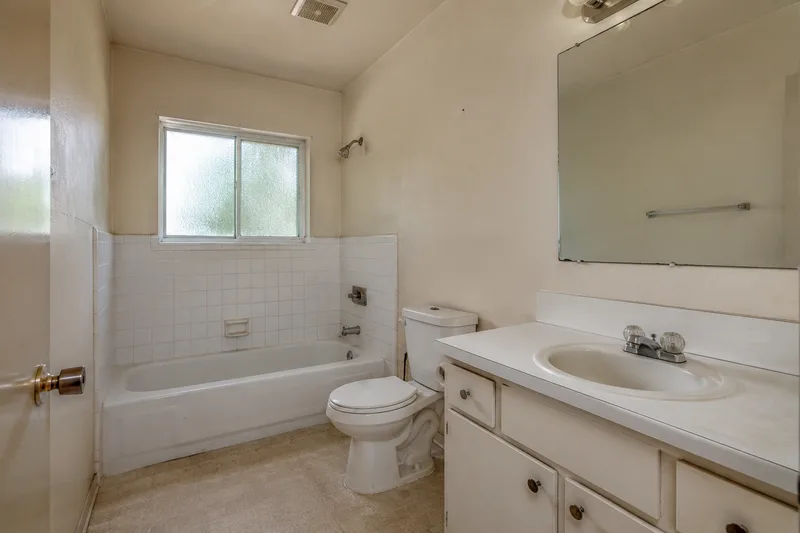
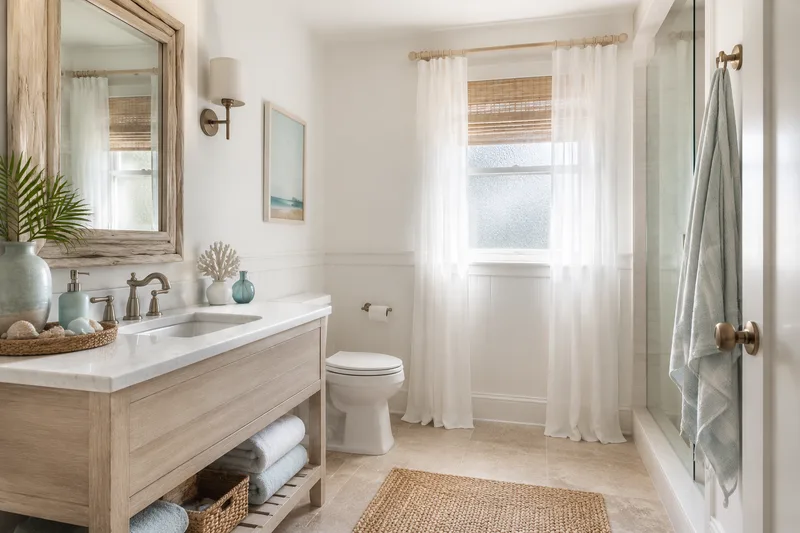
The before is a small bathroom with old white tile, a basic vanity, a dated mirror, beige walls and a frosted window under a harsh overhead light — and that overhead light is the first thing to fix, before any tile is touched. In the after the sanitaryware has not moved and the window is the same frosted window.
What actually changed is the temperature of everything: the beige wall goes to a cleaner sand, the light goes warm, the hard surfaces gain a woven note and a wood note, and the mirror stops being the only reflective object competing with the tile. Coastal is a low-contrast style, and low contrast is exactly what a small bathroom wants.
Bathrooms are where render images most often mislead by omission, so it is worth saying plainly: an AI render will happily place an untreated oak stool and a jute mat next to a shower. The image is right about the look and wrong about the lifespan. Take the palette and the light from it, and choose the materials with the wet room in mind.
Cheapest first, and why retiling is usually unnecessary
In a tiled room every surface reflects whatever the bulb is doing, which is why the cheapest item on this list outperforms items that cost a hundred times more.
- Lamps and light — cheapest
- Swap the harsh overhead fitting, or just its bulb, for warm white. In a small tiled room this changes more than any single object, because every surface is reflecting whatever colour the lamp is.
- Textiles — cheap
- Sand and white linen towels, a woven mat, and a sheer at the window instead of a permanently closed blind. Three purchases and no tools.
- Paint — cheap, with one rule
- Sand or soft white above the tile line, in a bathroom-grade paint. Standard matt emulsion in a room that steams twice a day is a false economy; the moisture-resistant version exists for a reason.
- Vanity and mirror — the middle
- A sealed-timber or wood-effect vanity and a plain wood-framed mirror carry most of the coastal signal in a bathroom, and neither is a plumbing job if the sizes match.
- Retiling — the real spend, and often unnecessary
- Matte white or sand tile is the ideal, but the palette above works over plain white tile you already have. Regrouting to a matching colour is the cheap version of a retile and removes the grid effect that dates a bathroom.
- Skip
- Anything literal — anchors, rope, starfish, driftwood signs. Coastal is a palette and a quality of light, not a theme; the moment there is a seashell on the wall it stops being an interior style.
The exact instruction that produced the after image
No hidden prompt engineering. The after image at the top of this page was generated from the before photograph using the style instruction below, and the same string is what the live renderer sends when you pick coastal for your own room.
coastal interior design, light and breezy, soft palette of white, sand, pale blue and natural linen, weathered light wood, woven jute, airy sheer curtains, relaxed beach-house calm, bright natural light
coastalSources, and how to check this
- The style instruction quoted above is this site’s coastal descriptor, and the same text sits behind every coastal image in the coastal gallery.
- The free-tier limits (2 renders a day, no account, no email) and the image licence are stated in the site’s terms. Before and after both come from the reviewed gallery set.
- The wet-room caveats above are material properties, not preferences: jute is a plant fibre that absorbs and retains moisture, and untreated timber in a bathroom needs either a seal, a moisture-rated core, or a tile that imitates it.
Where to go next the same bathroom in all six styles coastal across six rooms staging an empty room instead render your own room, free
Render your own bathroom in coastal
Free · no login · your photo is sent only when you click Redesign, used once for your render — never stored, never used to train models.
Upload a photo of your bathroom, pick coastal, and see it back in a few seconds. Free, no login, 2 renders a day.
Need more than 2 a day?
Two free renders a day stay free, forever. Credit packs add more — no account, no subscription, and they never expire.
40 renders
$4.90
$0.12 per render · one-off
Enough to try every style in a few rooms.
100 renders
$9.90
$0.10 per render · one-off
For a whole home, or a listing you are staging.
Your code appears on screen right after payment — no account, it works on any device, and there is nothing to cancel. Credits never expire, and purchases are final. Payment is handled by Stripe; we never see your card. Your receipt and card statement will show Clize.ai, our payments provider.
Coastal Bathroom — FAQ
What colours make a bathroom coastal?
White as the majority, sand as the warm mid-tone and pale blue used once as an accent. The mistake is making the blue the base colour — coastal reads as a warm neutral room with a blue note, not as a blue room.
Do jute and wood survive in a bathroom?
Only with care. Jute absorbs and holds moisture, so a jute mat needs to sit away from the shower and dry flat between uses. Wood must be sealed hardwood, a moisture-rated engineered board, or wood-effect tile; untreated pale wood does not last in a wet room.
Can a coastal bathroom work without a big window?
Yes. Coastal is a low-contrast, warm-neutral palette, and low contrast is what makes small dim rooms look larger. Get the light temperature right — warm white — and the palette does the rest.
Do I have to retile to get a coastal bathroom?
No. Over plain white tile, changing the grout to a matching colour, the light to warm white and the textiles to sand and linen gets you most of the way. Retiling is the ideal, not the requirement.