Industrial Living Room
A dim living room is a problem for five of the six styles on this site. For industrial it is a starting advantage — here is why.
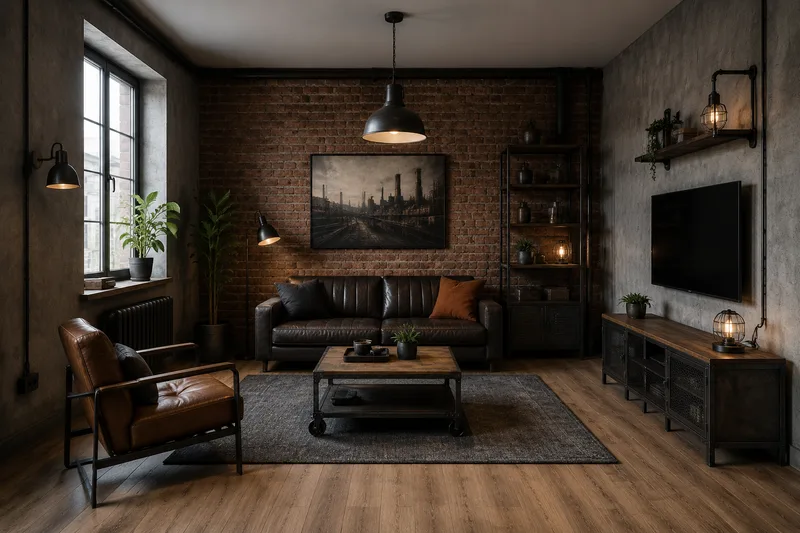
An industrial living room borrows the materials of a converted workspace: exposed brick and concrete, dark metal and aged wood, leather, a moody palette of charcoal, rust and warm brown, filament and matte-black lighting, and warm directional light rather than a flat ceiling wash.
Updated 5 September 2026
It is a materials palette before it is a colour palette, which is why it survives being done cheaply better than any other style here — a matte-black lamp and one leather object read industrial in a way that colour alone never will. Below is each material, then what is worth faking and what is not.
The four material signals, and the light
- Palette
- Charcoal, rust and warm brown over a mid-grey base. The warmth is essential: charcoal plus cool grey plus white is not industrial, it is an office. The rust note is what stops that happening.
- Surfaces
- Brick, concrete or textured plaster on one wall — not four. Industrial reads as one raw surface in a room of finished ones; four brick walls stop reading as a converted space and start reading as a basement.
- Metal and leather
- Matte black or aged steel on legs, frames, shelf brackets and lamp bodies, plus one leather piece — a chair, a cushion, a strap detail. Leather is the material that carries the age; a room of black metal without it is merely severe.
- Wood
- Aged, open-grain, mid to dark. Reclaimed boards, a thick tabletop, visible saw marks. Pale Scandinavian oak in an industrial room is the most common wrong note in the whole style.
- Lighting
- Directional and warm. Filament-look lamps sit at the warm end of the domestic range, roughly 2200–2400 K, in matte-black shades that aim light at a surface instead of spreading it. The pooling and the shadows are part of the look; even lighting flattens it.
The moment the room becomes industrial
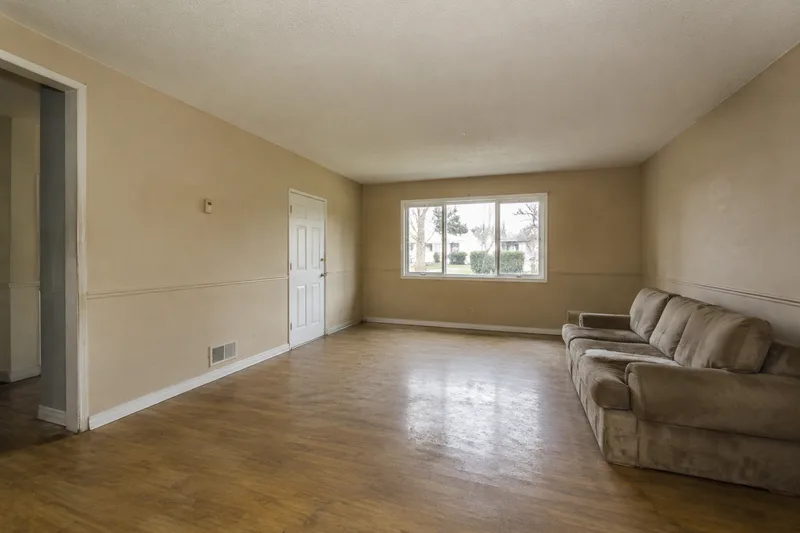
The before is a plain living room with beige walls, an old sofa, scuffed laminate and a small window — dim, but dim in a flat and uninteresting way. Industrial is the one style on this site that actively wants a darker room, which is why it suits a before photograph that other styles would struggle with.
In the after, notice what did not happen: the room did not get brighter. It got more contrast. Dark surfaces, a warm directional light pooling on one of them, and a leather note in the middle of the frame. Drag the slider slowly and the moment the room turns industrial is not a colour change, it is the shadows arriving.
The practical warning is scale. Industrial materials are heavy, and in a room with a small window they will close it down. In a room like this one, keep the raw surface to a single wall and keep the ceiling light-coloured. The style survives that compromise far better than it survives a fully dark box.
The cheapest change is also the most convincing
This is the one style on the site where the smallest purchase on the list is the one that most reliably makes the room read correctly in a photograph. Ordered cheapest first.
- Lighting — cheapest, and the biggest lever
- A matte-black shaded lamp with a filament-look bulb. Of everything here this is the change that most reliably makes a photograph of the room read industrial, and it is the smallest thing to buy.
- Metal details — cheap
- Matte-black paint on existing lamp bodies, curtain poles and shelf brackets. Replacing shiny chrome with matte black across a room costs very little and removes the single most anti-industrial finish there is.
- Paint — the middle
- One wall in charcoal or a textured mid-grey, matt. Brick slips and brick-effect wallpaper are the two standard fakes: slips hold up close to, wallpaper only in photographs.
- Leather and aged wood — the real spend
- A leather chair or a thick reclaimed-wood table is the part that cannot be imitated, because both are materials that show age, and age is exactly what the style is imitating.
- Skip
- Pipework shelving as the only industrial element, and cool-white bulbs. Cool white in a charcoal room produces precisely the grey office look this style exists to escape.
The exact instruction that produced the after image
No hidden prompt engineering. The after image at the top of this page was generated from the before photograph using the style instruction below, and the same string is what the live renderer sends when you pick industrial for your own room.
industrial interior design, exposed brick and concrete, dark metal and aged wood, leather, moody palette of charcoal, rust and warm brown, edison and matte black lighting, raw utilitarian materials, warm directional light
industrialSources, and how to check this
- The style instruction quoted above is this site’s industrial descriptor, and the same text sits behind every industrial image in the industrial gallery.
- The free-tier limits (2 renders a day, no account, no email) and the image licence are stated in the site’s terms. Before and after both come from the reviewed gallery set.
- Colour temperatures follow the standard lamp-labelling scale, where the filament-look “extra warm” range sits around 2200–2400 K and “warm white” at about 2700 K. The value is printed on the lamp box.
Where to go next the same living room in all six styles industrial across six rooms industrial in an apartment living room render your own room, free
Render your own living room in industrial
Free · no login · your photo is sent only when you click Redesign, used once for your render — never stored, never used to train models.
Upload a photo of your living room, pick industrial, and see it back in a few seconds. Free, no login, 2 renders a day.
Need more than 2 a day?
Two free renders a day stay free, forever. Credit packs add more — no account, no subscription, and they never expire.
40 renders
$4.90
$0.12 per render · one-off
Enough to try every style in a few rooms.
100 renders
$9.90
$0.10 per render · one-off
For a whole home, or a listing you are staging.
Your code appears on screen right after payment — no account, it works on any device, and there is nothing to cancel. Credits never expire, and purchases are final. Payment is handled by Stripe; we never see your card. Your receipt and card statement will show Clize.ai, our payments provider.
Industrial Living Room — FAQ
Can you do an industrial living room without exposed brick?
Yes, and in a small room it is usually better. Brick is one of four material signals, and the other three — matte-black metal, aged wood and warm directional light — are enough on their own. A charcoal wall stands in for brick perfectly well.
What lighting makes a room look industrial?
Directional and warm. Matte-black shades that aim light at a surface, filament-look lamps at the warm end of the range at roughly 2200–2400 K, and a deliberate absence of even ceiling light so that shadows form.
Does industrial style work in a small living room?
With restrictions. Keep the raw surface to one wall, keep the ceiling light-coloured, and put the darkest materials into small objects rather than large ones. Every dark surface in a small room costs you daylight.
What is the difference between industrial and modern?
Modern removes texture and colour to leave clean surfaces; industrial keeps texture and age on purpose. Both use charcoal, but modern pairs it with white and matte neutrals while industrial pairs it with rust, brown and leather.