Scandinavian Living Room
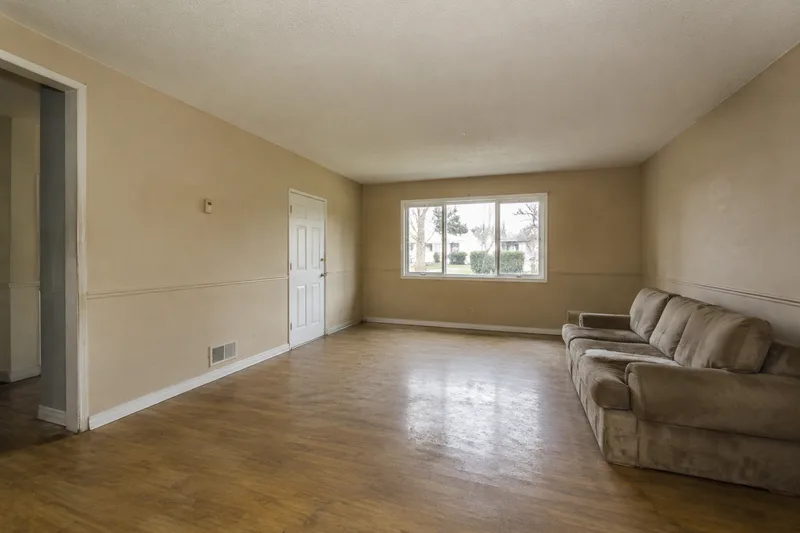
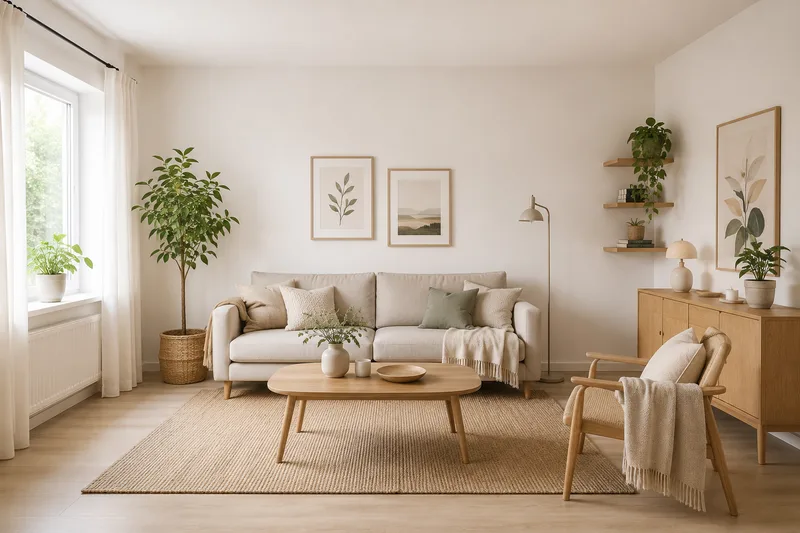
A dim beige living room with one small window, restyled Scandinavian. The window did not get bigger — here is what actually changed.
A Scandinavian living room is a living room built around light: white walls, pale wood floors, light natural oak furniture, cosy hygge textiles, greenery and simple functional pieces, arranged so that whatever daylight the window gives is neither blocked nor absorbed.
Updated 5 September 2026
It is the most literal of the six styles. It exists because Nordic winters are dark, so every decision either adds light or refuses to take it away. Below is the palette, the wood, the textile layer and the window treatment — then the cheapest route to most of it.
Five decisions, in the order they matter
- Palette
- White or near-white walls, pale wood as the second colour, and one muted accent — dusty blue, sage, soft black. Nothing saturated. The accent exists to stop the room reading as a blank, not to be noticed.
- Floor and wood
- Pale: white oak, ash, or a whitewashed board. This is the one style where the floor matters more than the furniture, because a dark floor absorbs the daylight everything else is trying to keep.
- Textiles
- The hygge layer, and it is not optional. A wool throw, a sheepskin or chunky knit on the seating, one flat-weave rug. It is what separates a Scandinavian room from a bare white room, and it is the part most copies leave out.
- Windows
- Sheer, or nothing. Heavy full-length drapes are the most common mistake in this style — they eat the daylight the whole scheme is built on. After dark, several small warm lamps instead of one bright ceiling light.
- Layout and greenery
- Furniture pulled slightly off the walls, legs visible rather than skirted bases, at least one real plant. Visible legs let light travel underneath, which is why the room reads airier than its floor area.
Reading the before and after
The before is a living room with beige walls, a worn sofa, scuffed laminate and a small window — and the small window is the interesting part, because it is the exact constraint this style was designed around. In the after the window has not grown. What changed is that nothing in the room competes with it any more.
Whitening the walls and lightening the floor tone are the two structural moves, and between them they account for most of the brightness difference. Everything after that is texture: the throw, the rug, the plant. Notice that the after is not minimal — there are more soft objects in it than in the before. Scandinavian is often confused with minimalism, and a bare white room is the result.
The mistake this style punishes is temperature. White walls under a cool 4000 K bulb go blue and unfriendly, and no amount of sheepskin repairs that. Warm-white lamps against white walls is the combination that actually produces the effect people are searching for.
Cheapest first: paint, curtains, textiles, floor
The order here is unusual, because the second item on the list costs less than a rug and does more than one. Most guides put it fourth or leave it out.
- Paint — cheapest
- White walls, matt. A warm white rather than a brilliant white: brilliant white against a grey winter sky is the coldest surface you can put in a room.
- Curtains — cheap and badly underrated
- Replacing heavy drapes with a sheer panel, or with nothing at all, is the highest-return change in this entire style. It costs less than a rug and it changes every daylight hour in the room.
- Textiles — second
- One wool throw, one flat-weave rug, one cushion in the muted accent. If you can only buy one, buy the throw: it lands in the middle of the frame and it is the object that says hygge.
- Floor — the real spend
- A pale floor is the change you cannot fake in a real room, only in a render. A large light rug covering most of the seating area is the honest halfway house, and it is what most people actually do.
- Skip
- Grey everything. The Scandinavian look that dominated the 2010s was grey; the version that has aged well is white plus wood plus one muted accent, and the difference is entirely in the wood.
The exact instruction that produced the after image
No hidden prompt engineering. The after image at the top of this page was generated from the before photograph using the style instruction below, and the same string is what the live renderer sends when you pick Scandinavian for your own room.
scandinavian interior design, bright and airy, white walls, pale wood floors, light natural oak furniture, cozy hygge textiles, greenery, simple functional pieces, abundant soft daylight
scandinavianSources, and how to check this
- The style instruction quoted above is this site’s Scandinavian descriptor, and the same text sits behind every Scandinavian image in the Scandinavian gallery.
- The free-tier limits (2 renders a day, no account, no email) and the image licence are stated in the site’s terms. Before and after both come from the reviewed gallery set.
- Colour temperatures follow the standard lamp-labelling scale, where “warm white” is about 2700 K and “neutral white” about 4000 K — the value is on every LED lamp box.
Where to go next the same living room in all six styles Scandinavian across six rooms how to decorate a living room render your own room, free
Render your own living room in Scandinavian
Free · no login · your photo is sent only when you click Redesign, used once for your render — never stored, never used to train models.
Upload a photo of your living room, pick Scandinavian, and see it back in a few seconds. Free, no login, 2 renders a day.
Need more than 2 a day?
Two free renders a day stay free, forever. Credit packs add more — no account, no subscription, and they never expire.
40 renders
$4.90
$0.12 per render · one-off
Enough to try every style in a few rooms.
100 renders
$9.90
$0.10 per render · one-off
For a whole home, or a listing you are staging.
Your code appears on screen right after payment — no account, it works on any device, and there is nothing to cancel. Credits never expire, and purchases are final. Payment is handled by Stripe; we never see your card. Your receipt and card statement will show Clize.ai, our payments provider.
Scandinavian Living Room — FAQ
What is the difference between Scandinavian and Japandi?
They share the light wood and the restraint. Scandinavian is brighter and softer — white walls, pale floors, wool and sheepskin. Japandi is warmer and darker in the mid-tones, with beige and clay in place of white and a soft-black anchor that Scandinavian rooms rarely use.
Does a Scandinavian living room need a pale floor?
It needs a light one. Pale oak or ash is the ideal; over an existing dark floor, a large light rug covering most of the seating area is the standard compromise and gets most of the effect.
Why does my white living room feel cold rather than Scandinavian?
Usually two reasons: a brilliant white rather than a warm white on the walls, and cool-white bulbs. Change the lamps to warm white first — it is the cheaper of the two fixes and it is often the only one you need.
Can this work in a rented flat?
Most of it. Curtains, textiles, a rug, lamps and plants are all portable and cover four of the five decisions above. Only the floor is the landlord’s territory.